
When Talking About Literacy Feels “Brave”

I’m writing this the day after the Right to Read Ireland conference, and my mind is still buzzing.
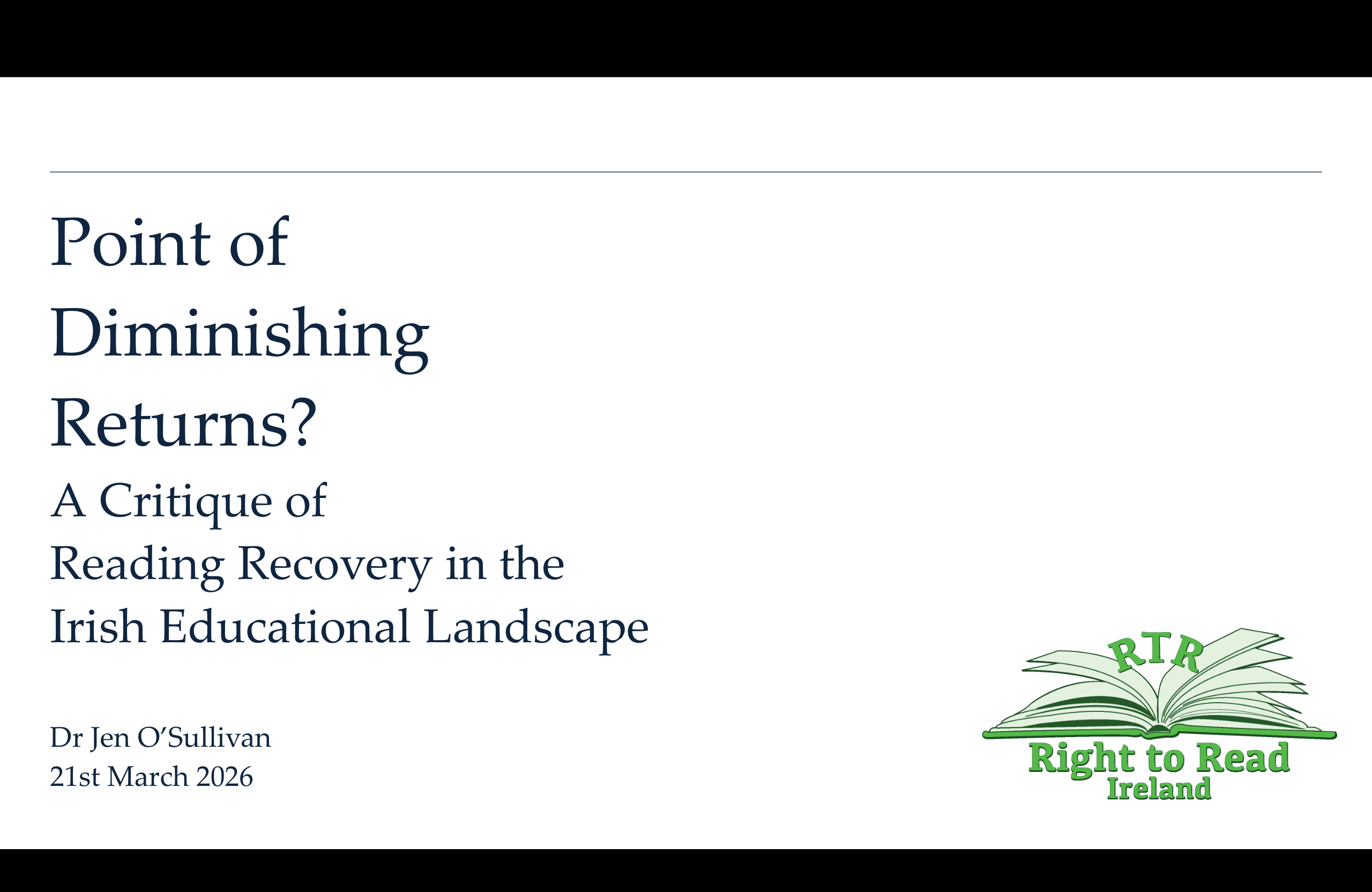
It was a wonderful event, energising, generous, and deeply focused on improving literacy outcomes for children. But it wasn’t just the insightful keynote sessions or presentations that stayed with me. It was something quieter. In the moments after a session in which I presented a critique of Reading Recovery in the Irish educational landscape (see below), a number of colleagues and teachers came up to me, not to challenge the argument, but to say, often quite earnestly, that I had been “brave” to speak about it so openly.
I understood exactly what they meant, and I appreciated the spirit in which it was said. But I have to admit that the comments lingered, and not entirely comfortably, because of what this idea of “bravery” might suggest about the current state of professional dialogue in literacy education in Ireland. When raising questions about instructional approaches, questions grounded in research and motivated by a desire to improve outcomes for children, is framed as an act of courage, it begins to signal that such conversations may not be as easy, or as welcome, as they should be.
This is not, of course, a simple issue, nor is it unique to any one programme or context. However, it does invite us to pause and consider why certain aspects of literacy instruction, particularly those that are long-established, widely implemented, and deeply embedded in professional systems, can feel unexpectedly difficult to discuss openly.
When Instructional Conversations Feel Personal
One of the central challenges in this space is that approaches to literacy instruction are rarely experienced as neutral or abstract. They are enacted daily in classrooms, shaped through professional learning, and sustained through relationships with children, colleagues, and communities. Teachers invest not only time and expertise, but also a great deal of emotional energy in the work they do, particularly when supporting children who are experiencing difficulty with reading.
Over time, specific programmes and approaches can become intertwined with professional identity. They come to represent not just a way of teaching, but a way of understanding one’s role as a teacher. In this context, raising questions about an intervention such as Reading Recovery can feel less like a discussion about instructional design and more like a commentary, however unintended, on the work of individuals. Even when critiques are carefully framed and evidence-informed, they can be experienced as personal, and this has a natural dampening effect on open dialogue.
It is perhaps unsurprising, then, that many teachers proceed cautiously in these conversations, choosing their words with care or, in some cases, choosing not to speak at all.
The Influence of Legacy and System
Reading Recovery occupies a particularly significant position within literacy education, both in Ireland and internationally. For many years, it has been associated with early intervention, professional expertise, and a commitment to supporting children with the greatest needs. It has shaped training pathways, influenced school structures, and built strong professional communities.
With this level of institutional and historical significance comes a certain degree of protection, albeit often implicit. Questioning such a programme can feel like questioning more than a set of instructional practices; it can feel like challenging a legacy, a body of work, and a network of dedicated professionals. In this sense, the conversation becomes layered, extending beyond pedagogy into the realm of professional culture.
Cultural factors also play a role. In contexts such as Ireland, where collegiality and relational trust are highly valued, there can be an understandable reluctance to engage in discussions that may be perceived as confrontational or divisive. Professional politeness, while an important and positive feature of our educational communities, can sometimes lead to a softening of critique or a tendency to circle around, rather than directly address, points of tension.
Evidence, Change, and Discomfort
Overlaying all of this is the evolving evidence base in reading research. Over recent decades, there has been increasing clarity regarding the processes that underpin successful reading development, including the role of phonemic awareness, systematic phonics, and the mechanisms involved in building robust word recognition through the process of orthographic mapping.
As this body of research has grown, so too has the need to examine how well existing practices align with what we now understand about how children learn to read. This process of alignment is not always straightforward. It may require adaptation, rethinking, or, in some cases, more fundamental change. Such shifts can be professionally and emotionally demanding, particularly when they intersect with long-standing practices and deeply held beliefs.
In this context, discomfort is not only inevitable but, arguably, necessary. It signals that the profession is engaging with new knowledge and grappling with its implications. The difficulty arises when that discomfort leads to silence rather than dialogue.
The Subtle Cost of Not Speaking
When open discussion is constrained, whether by concern for relationships, respect for legacy, or uncertainty about how critique will be received, there is a risk that important questions remain unexamined. Practices may continue not because they are the most effective available, but because they are the most established or the least questioned.
The level of engagement at the Right to Read Ireland conference suggests that many teachers are thinking deeply about research, reflecting on their practice, and noticing where there may be mismatches between what they are implementing and what the evidence suggests. When there are limited opportunities to explore these observations collectively, they can remain internalised, leading to a quiet sense of professional isolation.
At a system level, the absence of open dialogue can slow the pace of improvement. Professions evolve through conversation, through the careful weighing of evidence, the sharing of perspectives, and the willingness to reconsider and refine practice over time.
Rethinking “Bravery”
Perhaps, then, the most interesting aspect of those post-conference conversations was not the content of the critique, but the language used to describe it. The idea that it was “brave” to speak openly invites us to reflect on what we perceive as risky within our professional communities.
In many ways, it should not require bravery to engage in evidence-informed discussion about literacy instruction. It should be a routine and expected part of professional life. At the same time, acknowledging the complexities outlined above, it is understandable that such conversations can feel challenging.
Rather than dismissing the notion of bravery altogether, we might instead reframe it. Not as something reserved for bold or controversial statements, but as a quieter, more collective endeavour: the willingness to ask questions, to listen carefully to differing perspectives, and to remain open to change.
Towards a More Open Professional Culture
If we are to support the continued development of literacy instruction in Ireland, it is important that we create conditions in which these conversations can take place productively. This involves maintaining a clear distinction between critique of practice and critique of people, grounding discussions in evidence while recognising the realities of classrooms, and approaching dialogue with both intellectual rigour and professional respect.
It also requires a shared understanding that revisiting and refining our approaches is not a sign of failure, but a hallmark of a healthy and responsive profession. Educational practices are not static, and neither is our knowledge of how children learn to read.
In this sense, the goal is not consensus, but open dialogue and conversation.
An Ongoing Conversation
The Right to Read Ireland conference was, in many ways, a reminder of what is possible when teachers come together with a shared purpose and a commitment to learning. The energy, curiosity, and openness evident across sessions suggest that there is both an appetite and a readiness for deeper engagement with these issues.
Perhaps the next step is to carry that spirit forward into the more difficult conversations as well, creating space for thoughtful, evidence-informed discussion about all aspects of literacy instruction, including those that feel most complex.
If doing so is currently perceived as brave, then that in itself is worth reflecting on. But more importantly, it may signal an opportunity: to move towards a professional culture in which such dialogue is not the exception, but the norm.
When evidence-informed discussion is framed that way, it does hint at something deeper in the culture. Not a lack of professionalism, but perhaps a tension between respecting people and interrogating practice. The distinction you make is important. Critiquing an approach is not critiquing a person—but in reality, those lines blur because teaching is so tied to identity. That’s where the work sits. Maybe the shift is this: moving from “bravery” to shared responsibility—creating spaces where questioning, refining, and adapting practice is simply what we do.
Thank you, Jen, for this piece. It’s important that professionals involved in education don’t lose sight of the goal: teaching children to the absolute best of our collective ability. Bravery shouldn’t come into it. As professionals, we must be prepared not just to feel uncomfortable, but to sit with that, question why, and collaboratively find ways to improve.