
What Ireland Gets Right About Reading
Lessons from a small country with strong reading outcomes

In literacy, we spend a lot of time talking about problems.
We debate reading difficulties. We argue about instructional approaches. We scrutinise policies, programmes and interventions. We worry about achievement gaps and declining standards. If you’ve spent any time in literacy circles or at literacy conferences recently, you’ll know that much of the conversation revolves around identifying what isn’t working and trying to figure out how to fix it.
And rightly so. Reading matters. When children struggle to learn to read, the consequences can be profound and long-lasting. We should be concerned about those children and we should challenge practices that are not supported by evidence.
But that focus on problems can make it easy to overlook something important. Quietly, and perhaps without many of us noticing, Ireland has begun to attract serious international attention. Not for its problems, but for its strengths. While we were busy debating what needed to improve, other countries were beginning to ask what they could learn from us.
As someone who works in literacy education in Ireland, and who has contributed to many of those critical conversations myself, I found that observation worth pausing on.
Ireland is one of the strongest-performing English-speaking countries in the world when it comes to reading.
That doesn’t mean we’ve solved literacy. Far from it.
There are still children leaving our schools without the reading skills they need. Significant disparities remain between children from more affluent backgrounds and those from communities experiencing socioeconomic disadvantage. Not all reading instruction reflects the best available evidence. Practices such as guided reading, cueing prompts and levelled texts continue to exist in some classrooms despite growing concerns about their effectiveness for beginning and struggling readers.
There is much work still to do.
But acknowledging those challenges should not prevent us from recognising success where it exists.
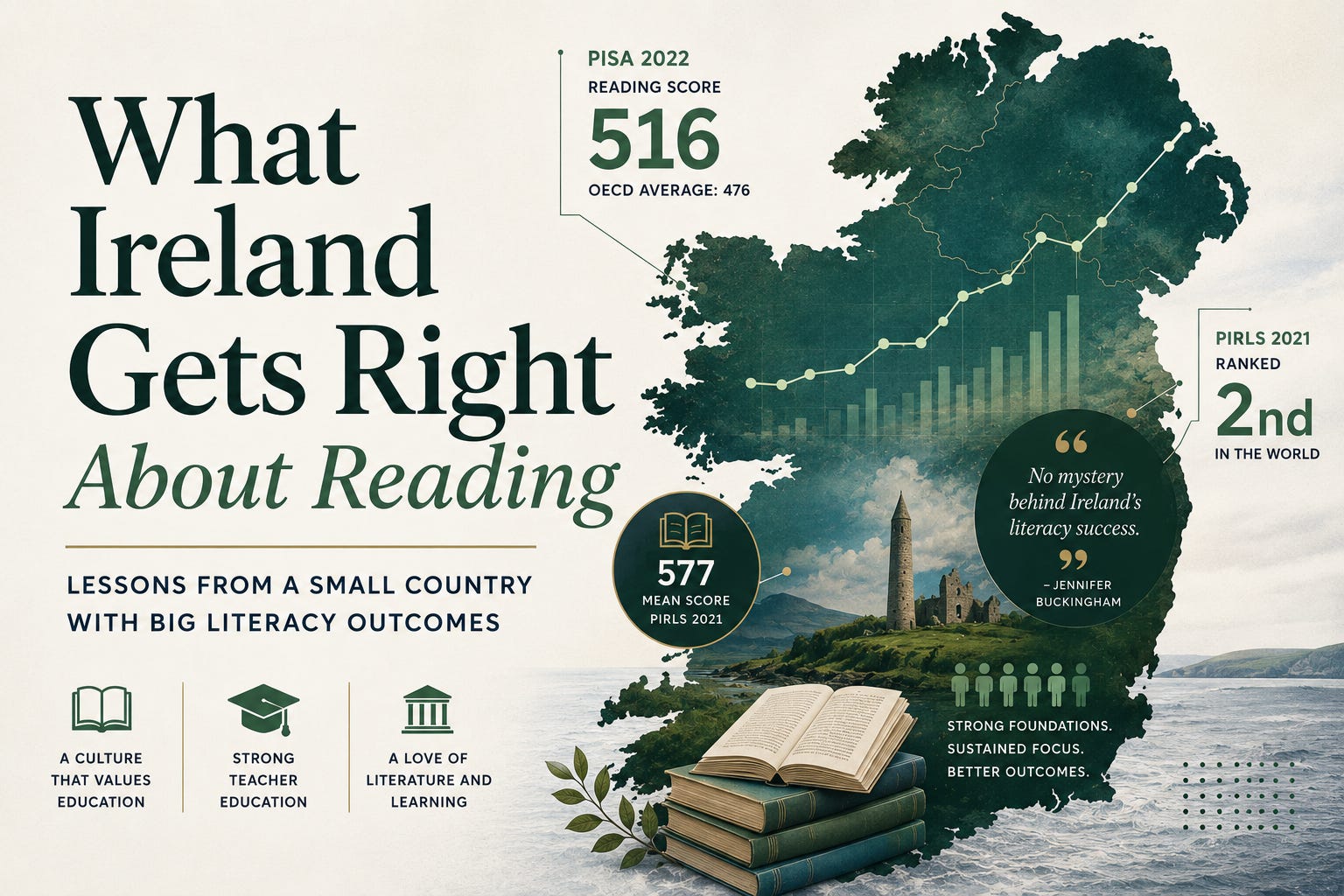
Over the past two decades, Ireland has consistently performed at a high level in international assessments of reading. In PISA 2022, Irish fifteen-year-olds achieved a reading score of 516, substantially above the OECD average of 476 and second only to Singapore among participating education systems. In PIRLS 2021, Ireland ranked second in the world, achieving a mean score of 577, eleven points higher than in 2016 and 25 points higher than in 2011, and no EU or OECD country achieved a score significantly higher than Ireland’s. It is worth noting, however, that Irish children were tested at the start of fifth class rather than the end of fourth class, as is the norm in most participating countries, a consequence of school closures during the COVID-19 pandemic. The older age of the cohort means we cannot draw straightforward comparisons with all other systems, and researchers have interpreted the results as suggesting that reading achievement in Ireland has at least remained stable since 2016, rather than conclusively improved. Even with that caveat, Ireland’s position among the very highest-performing countries internationally is well established across multiple cycles of both assessments.
These outcomes have attracted growing international attention. Jennifer Buckingham’s Churchill Fellowship report examined literacy instruction in Ireland to identify lessons for other jurisdictions. More recently, the National Center on Education and the Economy (NCEE) published a case study exploring why Ireland has become such a consistently strong performer in reading.
As an Irish literacy teacher educator, I found reading these reports oddly refreshing. We spend so much time discussing what isn't working that it can feel unusual to see international organisations asking a different question altogether: what is Ireland getting right?
There Is No Secret Formula
One of the things I appreciated most about both reports was their refusal to look for a miracle solution. There is no secret Irish reading programme, no single policy that explains our success, no literacy silver bullet. Instead, both reports arrive at a remarkably similar conclusion: Ireland’s literacy outcomes appear to reflect the cumulative effect of getting a lot of things broadly right over a long period of time. Jennifer Buckingham concludes that there is “no mystery” behind Ireland’s literacy success, while the NCEE report argues that Ireland’s achievements stem from a sustained focus on strong educational foundations. Perhaps that is less exciting than discovering a revolutionary intervention, but it may also be more useful.
We Value Education
The NCEE report repeatedly highlights the importance of education within Irish culture. Historically known as the ‘land of saints and scholars’, Ireland has long attached significant value to learning, books and education, and the report points to strong traditions of storytelling, literature and scholarship that continue to shape attitudes towards education today.
Of course, culture alone does not teach children to read. But it does create conditions in which reading is valued: conditions where children grow up in homes where books matter, where parents generally view education positively, where teachers are respected and where reading is seen as worthwhile. Those things are difficult to quantify, but they do matter.
We Attract Strong People Into Teaching
One of Ireland’s greatest strengths has little to do with literacy programmes and everything to do with people. Teaching remains a highly respected profession, entry into teacher education programmes is competitive, and many successful applicants come from among the highest-achieving school leavers. International reviews have noted the exceptionally strong academic profile of students entering teaching in Ireland.
This matters because teachers matter. A reading programme does not teach children to read. Teachers do. Too often, literacy conversations become dominated by commercial programmes, interventions and resources. While these certainly have a role to play, they are only ever as effective as the teacher implementing them.
We Take Teacher Education Seriously
Both international reports identified teacher preparation as one of the strengths of the Irish education system. Jennifer Buckingham’s Churchill Fellowship report highlights the quality of Irish teacher education and the strong emphasis placed on literacy within programmes preparing future teachers. Similarly, the NCEE case study identifies teacher education as one of the foundations underpinning Ireland’s educational success.
Teacher education programmes devote significant attention to language development, reading acquisition and literacy instruction. Future teachers engage with areas such as oral language, phonological and phonemic awareness, phonics, vocabulary development, reading comprehension and assessment. Importantly, the focus is not solely on understanding how reading develops but on understanding how to teach it.
This emphasis on pedagogy is particularly important. Knowing that phonemic awareness matters is one thing; knowing how to teach it effectively to a class of five-year-olds is another. Understanding the importance of vocabulary development is valuable; designing meaningful learning experiences that build vocabulary is where professional expertise comes into play. Irish teacher education has traditionally placed considerable emphasis on this relationship between theory and practice, ensuring that student teachers have opportunities to translate knowledge and research into effective classroom instruction.
As someone who works in initial teacher education, I know there is always room for improvement. Our understanding of reading development continues to grow, and teacher education must continue to evolve alongside it. Yet I was struck by the fact that two independent international examinations of Irish education, conducted for very different purposes, both highlighted teacher education as a key strength.
That should not surprise us.
Strong literacy outcomes do not happen by accident. They depend on knowledgeable teachers who understand reading development, understand children, and understand how to translate that knowledge into effective classroom practice.
We Built Strong Foundations in Early Reading
One finding that stood out in both reports was the extent to which systematic phonics is embedded in Irish schools. According to the NCEE report, approximately 95% of classes teach phonics daily, and synthetic phonics programmes have been widely used in primary schools for decades. This doesn’t mean implementation is always perfect, nor that all schools approach reading instruction in exactly the same way, but it does mean that Ireland already possesses many of the foundational structures that other countries are currently trying to build.
Importantly, phonics has generally existed alongside rather than instead of other valuable literacy experiences. The report highlights the continued importance of oral language, read-alouds and children’s literature within Irish classrooms, a balance that I think we sometimes overlook in literacy debates. Children need explicit instruction in how the alphabetic system works, and they also need language, stories, discussion and opportunities to build knowledge. These are complementary priorities, not competing ones. I have written about this in a previous post titled ‘Teaching Reading Well is not the Enemy of Reading Joy‘.
We Love Stories
If there is one aspect of Ireland’s literacy culture that feels difficult to capture in assessment scores, it is our relationship with stories. Ireland has a rich literary tradition. We celebrate poets, playwrights, novelists and storytellers, we have a long history of oral storytelling, and we have a deep cultural appreciation for language itself. The NCEE report explicitly identifies Ireland’s literary heritage and storytelling traditions as distinctive features of the Irish educational landscape.
Reading is not simply a technical skill. It is also a cultural practice. Yes, children need to develop phonemic awareness, decoding skills, vocabulary and comprehension. Those foundational skills are non-negotiable. But children also need reasons to read. They need to encounter books that make them laugh, wonder, question and imagine. They need to experience the pleasure of becoming immersed in a story.
One of the things I admire about many Irish classrooms is that they continue to make space for both. Alongside phonics lessons and spelling instruction, you will often find teachers reading novels aloud, discussing picturebooks, sharing poetry and nurturing a love of literature. The goal is not simply to produce accurate decoders. It is to develop readers.
We Understand That Knowledge Matters
Another theme running through the NCEE report is Ireland’s commitment to a broad curriculum. Irish children spend significant time learning history, geography, science, literature, music, drama and the arts, and the report suggests that one reason for Ireland’s strong reading outcomes may be the substantial background knowledge children acquire across these curriculum areas.
This aligns closely with what reading research increasingly tells us. Reading comprehension is not simply about applying strategies. It depends heavily on vocabulary and knowledge, and children understand texts better when they know more about the topics those texts discuss. For years, literacy conversations focused heavily on skills and strategies, but research is increasingly reminding us of the importance of content. Ireland’s commitment to a broad curriculum may be one reason our pupils perform so strongly in reading.
But We Cannot Be Complacent
At this point, it would be easy to paint an overly rosy picture, but that would be a mistake. One of the reasons I wanted to write this piece is because I believe we need to be able to hold two ideas at the same time: Ireland has many strengths, and Ireland also has significant challenges.
The achievement gap associated with socioeconomic disadvantage remains one of the most pressing issues facing Irish education. Children attending DEIS (designated disadvantaged) schools continue, on average, to achieve lower literacy outcomes than their peers in more affluent settings, and that gap has persisted across multiple assessment cycles.
We also need to continue improving the quality and consistency of reading instruction. Not all classroom practices align with contemporary evidence. Guided reading remains common in some settings, cueing prompts continue to appear in classrooms, and assessment practices do not always provide the information teachers need to identify the root causes of reading difficulty. Some struggling readers continue to receive support that focuses on compensatory strategies rather than building the foundational skills required for skilled reading. These are important issues, and they deserve serious attention.
A Success Story Worth Studying
When I finished reading both reports, I was struck by how similar their conclusions were. Neither points to a miracle programme or identifies a revolutionary intervention. Instead, both describe a system that has spent decades building strong foundations: high-quality teacher education, widespread phonics instruction, rich oral language experiences, a broad knowledge-rich curriculum, a love of literature and a culture that values education.
Of course, these are only my reflections on some of the factors that may be contributing to Ireland’s literacy success. There are undoubtedly other pieces of the puzzle. Ireland’s investment in free early childhood education, our commitment to play-based learning in the early years, and the support of families and communities have all helped shape the literacy landscape we see today. As with most things in education, success rarely has a single explanation. More often, it emerges from a combination of cultural, educational and policy decisions that accumulate over time.
Perhaps that is the real lesson. Strong literacy outcomes are built gradually, through sustained attention to the fundamentals rather than through quick fixes or silver bullets. As a profession, we should continue asking difficult questions about what needs to improve, advocating for children who are not yet being well served, and challenging practices that are not supported by evidence. But every now and then, it is worth pausing to recognise what is working, because understanding success may be just as important as understanding failure.
A Note of Caution for What Comes Next
Which makes it all the more important to pay close attention to decisions that could disturb these foundations.
The 2011 National Literacy and Numeracy Strategy was significant not only for what it changed in classrooms, but for what it signalled as a matter of policy: that literacy deserved dedicated time and structured attention. One of its direct effects was to increase the time allocated to the teaching of language and literacy in the primary school day. That decision mattered, and the strong international results Ireland achieved in the years that followed suggest it was the right one.
The 2023 Primary Curriculum Framework represents a different kind of policy signal. For all its merits, and there are genuine strengths in the new framework, it has reduced the mandated, explicit time for literacy instruction in Irish primary schools. Whether this reduction proves consequential remains to be seen, but in a system where instructional time is finite, choices about how it is allocated carry real weight.
The timing of this shift matters more than might be immediately obvious. PISA 2025 data was collected in spring 2025, with results due to be published later this year. PIRLS 2026 data collection is currently underway, with international results expected in December 2027. Together, these assessments will provide an important snapshot of reading achievement in Ireland at a moment when significant curricular change is beginning to take shape. While it will be many years before we can meaningfully evaluate the long-term impact of the new Primary Curriculum Framework, these results will establish an important reference point against which future trends can be considered.
Whether Ireland can maintain its high international standing, or whether the decisions being made today will register as a turning point into the future, is a question we will not be able to answer for some time yet. However, if future evidence suggests that adjustments are needed, there are good reasons to be optimistic. Ireland has demonstrated a capacity to reflect on educational practice, engage with new evidence and adapt when necessary. Those qualities will be just as important in the future as they have been in the past.
Love the line about "strong traditions of storytelling, literature and scholarship that continue to shape attitudes towards education today." You're exactly right--it's people, not programs. Too many here in America have the attitude of "Well, that's the school's job." But as you rightly note, there needs to be a culture of literacy where all people--parents, neighbors, co-workers, everyone--has an investment in passing on to children the history and traditions of the culture. Thanks for reporting what's going on Ireland!
It is interesting to hear how much Irish culture values education and that there there is no miracle approach to their growing literacy success. This culture of trust and perceived intrinsic importance is very reminiscent of what I understand and have seen in Finnish education as well. I'd be very curious if you had any thoughts on this comparison at all? I haven't read much about Irish education, so this was a very useful first dip into learning about it which I very much enjoyed.