
The most powerful vocabulary teaching tool in your classroom is probably already on your shelf

I was recently talking to a teacher about vocabulary instruction when she asked me: ‘How do I actually know which words are worth teaching explicitly?’
It sounds deceptively simple but once you begin planning read-alouds, selecting texts, or thinking carefully about vocabulary development, you realise how significant that question really is. Vocabulary requires deliberate, sustained attention across every year of primary school, woven into every subject, and every read-aloud. The words children know, and crucially the words they do not yet know, shape what they can understand, what they can learn, and what they can express. Vocabulary is not an isolated skill sitting off to the side. It is deeply interconnected with almost every aspect of comprehension development.
The research here is remarkably consistent. Vocabulary breadth and depth are strongly connected to reading comprehension and wider literacy outcomes. Children who know more words understand more of what they read. Children who understand more of what they read learn more from text. Over time, that knowledge compounds.
But perhaps the most important thing to understand about vocabulary is this: vocabulary is the mechanism through which knowledge itself develops. For example, a child who understands the word ‘migration’ is not simply learning a definition. They are building a conceptual framework that helps them make sense of birds, seasons, habitats, journeys and the natural world. Vocabulary gives children somewhere to ‘hang’ new knowledge as they encounter it.
Explicit or direct vocabulary teaching supports a wide range of learners, producing nearly double the effect size of incidental vocabulary encounters (Marulis and Neuman, 2010, cited in Brooks et al., 2025). Younger children in particular are more reliant on explicit explanation because they are less able than older readers to infer word meanings independently from context. And yet, as anyone who has spent time in primary classrooms knows, vocabulary instruction is often the first thing that gets squeezed. There is always something more urgent. Something more measurable. Something that feels easier to cover.
The three-tier framework and why it changes the question
In Bringing Words to Life (2002, revised 2013), Isabel Beck, Margaret McKeown and Linda Kucan gave teachers a genuinely useful way of thinking about vocabulary selection. Their three-tier framework is elegant in its simplicity.
Tier 1 words are the everyday words children typically know already: happy, dog, run. These rarely require explicit teaching.
Tier 2 words are high-frequency academic words that appear across many texts and subjects but may not yet be part of a child’s spoken vocabulary: reluctant, peculiar, trembled, transformed, glistening. These words are especially valuable because children are likely to encounter them repeatedly across different contexts and curriculum areas. They build the kind of general academic vocabulary that supports comprehension right across the curriculum.
Tier 3 words are domain-specific terms tied to particular topics or subjects: migration, camouflage, hibernation, emigration, metamorphosis. These words help unlock content knowledge and allow children to engage more deeply with science, history, geography and wider curriculum learning.
The framework shifts the question from Should I teach vocabulary? to Which vocabulary is most worth teaching?
The unexpected richness of picture books
A 2024 study in the Journal of Research in Reading found that both narrative and informational picture books expose children to vocabulary that extends well beyond the language typically encountered in everyday conversation (Green, 2024). Authors choose words for precision, rhythm, imagery and emotional impact rather than simplicity. The linguistic density of a well-chosen picture book is often far greater than it first appears.
Picture books create opportunities for explicit teaching in meaningful contexts. Children are encountering sophisticated vocabulary embedded within stories, illustrations, emotions, humour, information and discussion. The illustrations themselves do important work here too. When a child encounters the word ravenous alongside an image of a wide-mouthed beast eyeing up every animal in sight, the meaning is immediate and memorable in a way that a dictionary definition rarely is. Visual context allows teachers to introduce and discuss far richer vocabulary than children might be able to access through text alone.
Think about the language in The Ravenous Beast by Niamh Sharkey: ravenous, devour, scoff, gobble.
Think about the emotional vocabulary in The Squirrels Who Squabbled by Rachel Bright: squabble, rivalry, reluctant, determined.
Think about the rich historical and emotional language in When Jessie Came Across the Sea by Amy Hest: emigration, sacrifice, longing, determination.
Or the nature vocabulary woven through The Vanishing Lake by Paddy Donnelly: vanishing, seasonal, landscape, turlough.
Each of these books offers more than a story. They offer children beautifully crafted, vocabulary-rich encounters with ideas, emotions and the wider world. And importantly, each vocabulary encounter is also a knowledge-building encounter.
When a child encounters the word turlough in the context of a beautifully illustrated story about a disappearing lake in the west of Ireland, they are building schema related to landscape, weather, geography and the natural environment that will support future comprehension. That is why vocabulary instruction and knowledge building cannot really be separated.
The read-aloud context itself has consistently been shown to support vocabulary development (Baumann et al., 2003), but effective vocabulary instruction during read-alouds requires something beyond simply reading the text aloud fluently.
It requires intentionality.
It requires teachers to think carefully about:
which words are worth pausing at and defining
which words merit revisiting across the week
how words can be connected to wider curriculum knowledge
and how vocabulary can move from temporary exposure to lasting understanding
And that intentionality begins long before the lesson itself. It begins during the planning process.
The preparation challenge
Scanning a picture book to identify useful Tier 2 vocabulary takes genuine thought. Not every unfamiliar word is worth teaching, and deciding which words are likely to have the greatest instructional value requires the kind of professional knowledge that cannot be rushed.
A teacher needs to consider whether a word is likely to recur across other texts and subjects, whether it carries sufficient conceptual weight to merit time, and how it connects to the broader curriculum knowledge children are building. Tier 3 vocabulary brings its own considerations, particularly in thinking carefully about how specific terms link to wider content learning.
All of that thinking happens alongside everything else involved in planning a read-aloud: text selection, comprehension questions, discussion prompts, learning intentions. And time is often what teachers have least of.
This is the reason I wanted to create something that might make this aspect of planning a little easier …
A tool to support vocabulary planning
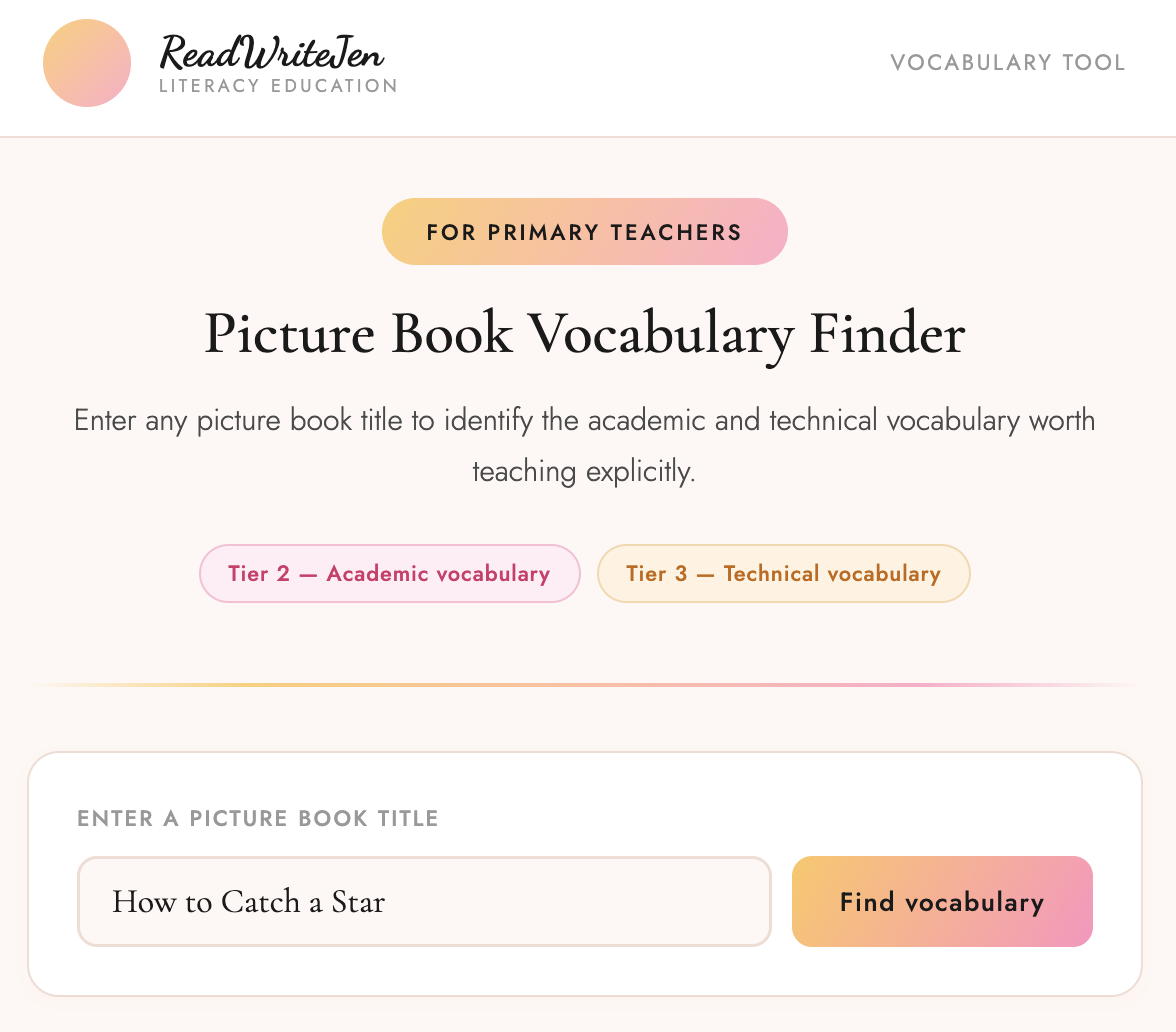
I recently developed a Picture Book Vocabulary Finder designed specifically to support teachers’ vocabulary planning for read-alouds. The idea behind it is simple: reduce the time involved in identifying useful vocabulary before teaching a picture book.
You type in the title of a picture book you’re planning to use and the digital tool generates a categorised vocabulary list organised into:
Tier 2 vocabulary worth explicit instructional attention
Tier 3 topic-specific vocabulary linked to content knowledge
Each word also includes:
a child-friendly definition
brief contextual information about how the word is used
and teaching notes that may support classroom discussion
The tool then allows teachers to print or save the vocabulary list as a PDF for planning purposes. What previously might have taken twenty minutes of scanning and sorting can now be done in seconds.
The literacy knowledge, pedagogical framework and instructional thinking underpinning the tool are grounded in my own work and experience in literacy education. The technical side was developed with the support of AI, specifically Anthropic’s Claude, and I think it is important to be transparent about that, particularly in an educational context.
The tool is available for a modest fee, which reflects the small amount of AI processing involved in each search. If there is a title you would like added or if you have any feedback, I would genuinely love to hear from you.
You can access the Picture Book Vocabulary Finder here.
The Picture Book Vocabulary Finder generates vocabulary suggestions based on AI knowledge of published picture books. It does not reproduce, store or display any text, illustrations or content from any published work. Book titles and author names are referenced for educational purposes only. This tool is intended to support teachers in planning vocabulary instruction and is not affiliated with or endorsed by any publisher or author.