
Literacy Stations: What Are We Actually Talking About?
Why the most important question isn't whether we use stations, but what happens within them.

I recently ran a poll over on Instagram asking teachers in Ireland whether they used ability grouping during reading instruction.
Of those who responded, 50% said that they did.
Curious about what this looked like in practice, I followed up with another question: What format do you use when grouping children for reading?
The responses were interesting.
Just over half (52%) reported using literacy stations. A further 18% said they used guided reading, while another 18% identified Literacy Lift Off as their preferred approach. The remaining respondents selected ‘other’.
Before I go any further, I’d like to thank everyone who took the time to engage with the polls and share their experiences. Social media polls are hardly scientific, but they can provide a useful snapshot of what is happening in classrooms and, perhaps more importantly, spark conversations that are worth having.
I also want to be clear that this article is not intended as a criticism of teachers who use literacy stations. Teachers make instructional decisions within the realities of their own classrooms, and many use literacy stations thoughtfully and effectively. My intention here is not to advocate for or against any particular approach. Instead, it’s to reflect on a practice that appears to be increasingly common in Irish classrooms and to consider some of the questions it raises.
The results got me thinking (as is often the case!).
Not about whether ability grouping is right or wrong. That’s a conversation for another day. Instead, I found myself wondering about the language we use to describe reading instruction and whether those labels tell us as much as we think they do.
Take Literacy Lift Off, for example.
For readers outside Ireland, Literacy Lift Off is a classroom intervention model that grew out of Reading Recovery. Children rotate through a series of literacy activities, typically including teacher-led reading, familiar reading, word work, writing and listening activities. Regular readers will know that I have significant reservations about aspects of the model, particularly some of the instructional practices associated with it. However, one thing that can be said for Literacy Lift Off is that if teachers mention they are using it, there is a relatively clear understanding of what is happening in each rotation. The structure is defined. The activities are specified. Whether one agrees with the approach is another matter entirely, but there is at least some consistency in what the term means.
Literacy stations feel different.
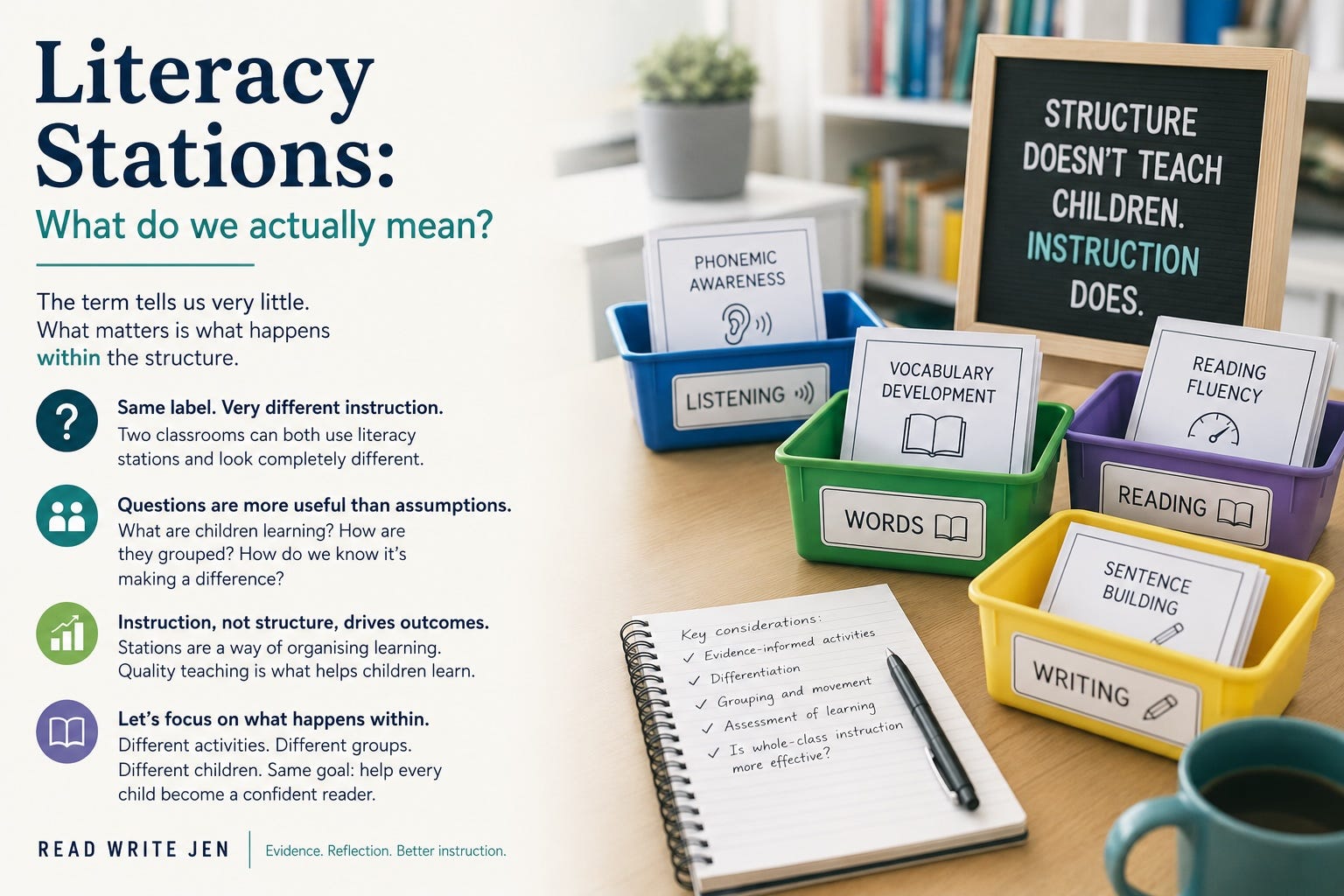
When someone tells me that their school uses literacy stations, I often realise that I still know very little about what is actually happening. Are children engaged in phonemic awareness activities? Phonics? Vocabulary development? Oral language? Reading fluency? Writing? Independent reading? Literacy-themed games? The term itself doesn’t tell us. And increasingly, I wonder whether literacy stations are in danger of becoming what balanced literacy eventually became: a label broad enough to encompass almost anything.
One of the challenges with balanced literacy was that two schools could use the same term while providing children with very different instructional experiences. The label suggested consistency, but the reality often looked quite different from one classroom to the next.
I sometimes wonder whether literacy stations are heading in a similar direction.
Two schools can both claim to use literacy stations. Two classrooms within the same school can both claim to use literacy stations. Yet the experiences of children in those schools or classrooms may vary dramatically. In one classroom, children may be engaging in carefully designed activities linked to recent teaching, revisiting phonics patterns, building vocabulary and applying learning through reading and writing. In another, children may spend substantial amounts of time completing activities that are engaging and enjoyable but only loosely connected to literacy development.
The structure remains the same.
The instruction does not.
And that distinction matters because literacy stations are not, in themselves, an instructional approach. They are an organisational structure. What ultimately matters is the quality of the teaching and learning that occurs within that structure.
This raises a number of questions that I think deserve more attention than they currently receive.
The first concerns the activities themselves.
Are they supported by evidence?
Most teachers would agree that literacy instruction should be grounded in the best available evidence. Yet once children move into independent stations, it can be surprisingly difficult to determine whether activities are contributing meaningfully to literacy development or simply occupying time. If a child spends fifteen or twenty minutes at a station, what knowledge or skill are they developing? Is the activity connected to previous instruction? Does it provide meaningful practice? Is it helping them become a more skilled reader or writer? These questions matter because not all literacy activities are equally effective.
A second question concerns what happens when the teacher is not there.
One of the assumptions underpinning many station models is that children can engage productively in independent literacy activities while the teacher or other teachers work intensively with another small group. For older pupils, this may be entirely reasonable. However, I sometimes wonder whether we underestimate the challenges this presents for our youngest learners. Children in junior and senior infants are still developing attention, self-regulation, working memory and the ability to follow multi-step directions independently. Asking them to engage meaningfully in literacy activities without adult support is not a trivial expectation.
The challenge is not simply one of classroom management. It’s one of learning.
When children misunderstand a task, who notices? When misconceptions arise, who corrects them? When a child is practising something incorrectly, how quickly is that addressed? When a child becomes disengaged, how much learning time is lost before an adult intervenes?
These questions become particularly important when activities involve new learning rather than practice of previously taught skills. Literacy researcher Tim Shanahan has repeatedly questioned the assumption that literacy centres and stations are inherently beneficial. His concern is not that stations are ineffective by definition, but rather that too much instructional time can be devoted to activities that receive little teacher oversight and whose impact on learning is often assumed rather than demonstrated. His argument is a simple but important one: independent activity is not equivalent to instruction. A child may look busy. They may even appear engaged. But neither necessarily tells us whether meaningful learning is taking place.
There is another challenge that receives relatively little attention in Irish discussions of literacy instruction.
In many classrooms, literacy stations involve children rotating between activities every 8-10 minutes. While this can create a sense of pace and variety, I sometimes wonder whether we sufficiently consider the cognitive demands that such frequent transitions place on some learners. For many children, particularly those experiencing reading difficulties, language difficulties, attention difficulties or broader learning needs, simply understanding what is expected at each station can require considerable mental effort. By the time they have settled into a task, recalled the instructions, gathered the necessary materials and begun engaging meaningfully with the activity, it may already be time to move on.
Ironically, the children literacy stations are often intended to support may be the very children who find the format most challenging.
A child who is struggling with decoding, for example, may need additional time to process information, rehearse new learning and experience success. Frequent transitions can interrupt that process. Similarly, children with attention or executive functioning difficulties may spend a disproportionate amount of their cognitive energy navigating the organisational demands of moving between stations rather than focusing on the literacy learning itself. A classroom in which children are moving purposefully between stations may appear highly productive. Yet for some learners, particularly those who require the greatest instructional support, the constant shift from one activity to another may reduce opportunities to consolidate learning, sustain attention and benefit from explicit teaching.
Differentiation raises another set of questions.
One of the most frequently cited advantages of literacy stations is that they allow teachers to cater for diverse levels of strengths or needs. In principle, this makes perfect sense. Children arrive in classrooms with different strengths, needs and experiences. However, differentiation is not simply a matter of placing children into different groups. Effective differentiation requires careful consideration of what children know, what they need to learn next and how instruction can help them get there. Without that level of intentionality, grouping can become an organisational strategy rather than an instructional one.
This naturally leads to another question.
How are groups formed and reviewed?
If children are grouped according to reading attainment, what assessment information informed those decisions? How often are groups revisited? Are children moving between groups as their needs change? These questions are important because ability grouping has a long and contested history in education. While flexible grouping can support learning, fixed groups can sometimes become self-perpetuating.
And then there is the question I find myself returning to most often.
Could some of these activities be taught more effectively through whole-class instruction?
In recent years, whole-class teaching has sometimes been portrayed as being at odds with differentiation and I’m not convinced this is necessarily true. A well-designed whole-class lesson can provide all children with access to high-quality instruction while still allowing teachers to scaffold learning, monitor understanding and provide additional support where needed. That doesn’t mean everything should be taught whole class. Far from it. But it does mean that the decision to use literacy stations should be driven by instructional purpose rather than habit or expectation.
These questions around station teaching have become increasingly noticeable in my work as a teacher educator.
Each year, I work with student teachers who are eager to implement evidence-informed approaches to literacy instruction that they are learning about in college. They learn about phonemic awareness, vocabulary instruction, oral language development, reading comprehension and writing. They are encouraged to think critically about how children learn and how teachers can best support that learning. Yet many tell me that they struggle to implement some of these approaches during school placement because literacy time is already organised around station teaching. Some want to teach a whole-class phonemic awareness or phonics lesson. Others want to engage children in explicit vocabulary instruction or shared reading. Often, however, they feel constrained by a structure that leaves limited room for alternative approaches.
There is one final issue that I think deserves consideration.
When literacy instruction is organised around stations, are we always directing teacher expertise towards the children who need it most?
Many station models are built on the assumption that each group receives roughly the same amount of teacher time but children do not require the same amount of support. The child who is struggling to blend phonemes, decode unfamiliar words or establish secure letter-sound correspondences may require considerably more teacher attention than the child who is already reading successfully. In fact, some children may require not only more teacher support but also longer periods of sustained engagement with a task. A model built around fixed rotations and equal teacher time may not always align with those needs.
Which brings me back to that Instagram poll.
The most interesting finding wasn’t that literacy stations were popular. It was that the term itself tells us remarkably little. Perhaps the conversation we need is not about whether schools should use literacy stations. Perhaps the more useful conversation is about what happens within them.
Are activities evidence-informed?
Are children receiving sufficient opportunities for explicit instruction and guided practice?
How are learning difficulties accommodated?
Could this be taught whole class?
How are groups formed and reviewed?
How do we know learning is taking place?
And are the children who need the greatest support actually receiving it?
These are not arguments against literacy stations. They are simply questions worth asking because literacy stations are a structure.
And structures, on their own, do not teach children to read.
Instruction does.
If you’ve enjoyed this article, please consider sharing it with a colleague or on social media. These conversations are always richer when more voices are involved. And if you’d like to follow future posts on literacy, reading instruction, and education, consider becoming a subscriber.
Thank you so much for this wisdom. Such an important question to sit with. I'd add one more to your list: what instruction has already happened before children arrive at the station?
Literacy stations work best not as the place where learning happens but as the place where learning is practiced.
The challenge is that in many classrooms the stations come first and the explicit instruction that should precede them either hasn't happened yet or hasn't gone deep enough.
A child who hasn't been thoroughly taught a routine whole group isn't ready to do it independently — no matter how well-designed the activity looks on paper.
I've been developing what I call a Practice That Travels framework, a small set of high-leverage routines that are explicitly taught whole group first, then released to centers only once students can do them independently.
The same routines run across completely different units and content areas, which means students aren't relearning the structure every time — they're just applying familiar moves to new content.
That familiarity is what makes genuine independent practice possible.
Your closing line says it perfectly: structures don't teach children to read. Instruction does. The stations are only as good as the instruction that came before them.
I wrote about this here if it's useful. https://leahmermelstein.substack.com/p/the-instructional-playbook-move-i?r=4uwjft&utm_campaign=post-expanded-share&utm_medium=web
So well articulated as always, Jen! Sometimes station activities are inadvertently expecting novices to ‘discover’ what is inherently undiscoverable or at the very least needs some degree of explicit instruction and guided practice 👏👏👏